
Why our CTO-as-a-Service team built Deckgauge — an open-source engineering intelligence platform

As a CTO-as-a-Service team, we walk into a new engineering organisation every few weeks. Different stack, different tools, different habits — but almost always the same opening question from the founder or board: “Is engineering healthy, and how would we even know?” Answering that honestly, and fast, is most of our job. Over the years we got tired of re-assembling the same answer by hand, so we built a tool to do it for us. We call it Deckgauge, and we’ve open-sourced it. This post explains why.
The recurring problem: leaders flying blind
Most of the companies we advise are not short on data — they’re drowning in it. Delivery lives in Jira. Code lives in GitHub or GitLab. Some teams run Azure DevOps. Reviews, deployments and incidents are scattered across all of them. The result is that the person accountable for engineering outcomes — a founder, a VP, or us acting as their fractional CTO — has no single, trustworthy view of what’s actually happening.
The commercial tools that promise to fix this — Jellyfish, LinearB and friends — are genuinely capable, but they come with per-seat pricing that scales painfully and a data model you don’t control. For a company still finding its footing, that’s a hard sell. And the open-source option most people reach for, Apache DevLake, gives you a database and a pile of dashboards to assemble yourself — useful, but not a finished product. We wanted something our clients could adopt in an afternoon and actually keep.
One board over every tool

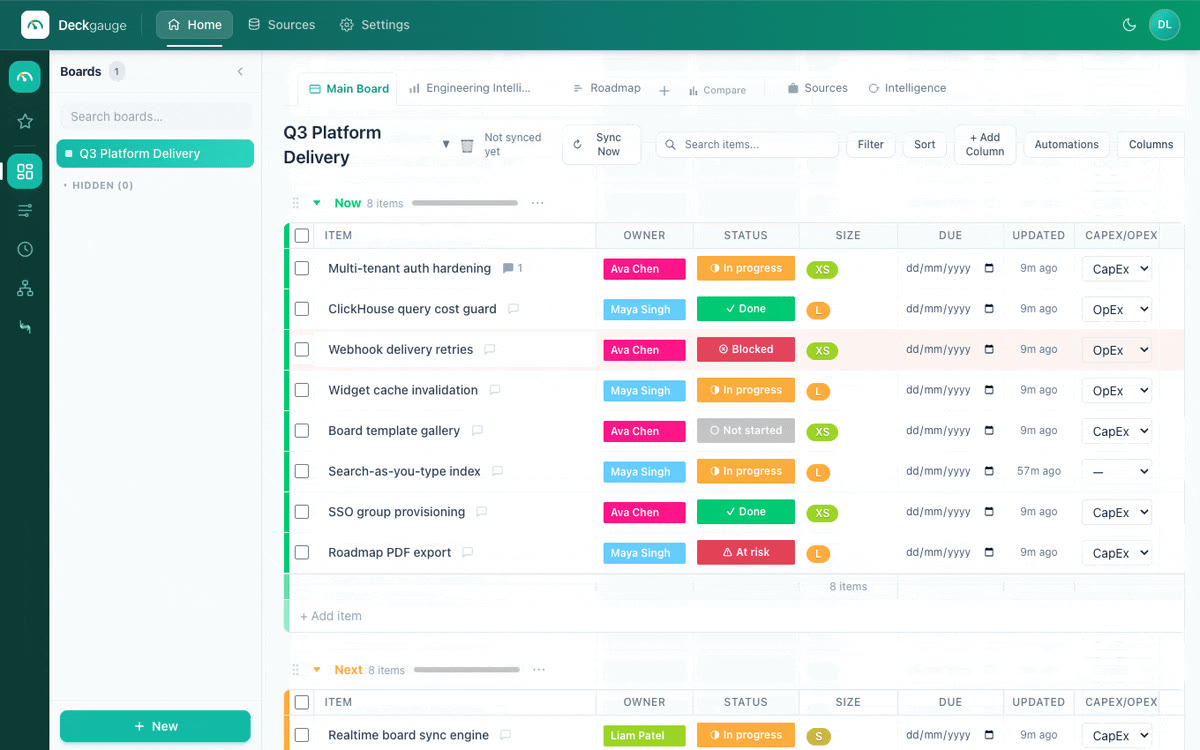
Deckgauge syncs Jira, GitHub, GitLab and Azure DevOps into one place and presents it as something engineering leaders already understand: a Monday-style board, plus dashboards on top. Issues, epics, pull requests and commits flow in on a schedule; a leadership view lets you prioritise, comment and set due dates without touching the underlying systems (Jira stays strictly read-only). Roadmaps generate themselves from that same board data, so the slide you show the board on Monday is never out of date with reality.
That single view is the thing we reach for first on a new engagement. It turns “let me get back to you next week” into an answer in the room. You can see the full feature set on the Deckgauge site.
Metrics you can trust — DORA without the theatre

Every leader wants DORA metrics; almost nobody wants the behaviour that shows up when you measure them badly. Point a dashboard at deploy frequency and you’ll get more, smaller, emptier deploys. The metric goes up; nothing improves. We wrote about how we try to avoid that trap in DORA metrics without gaming them — the short version is that the four numbers only mean something when they’re read together and tied back to real delivery, which is exactly how Deckgauge presents them.
The same principle applies to people. It is dangerously easy to turn engineering telemetry into surveillance, and we won’t do it — not for our clients and not in our own tool. Deckgauge leans on team-level aggregates and evidence-based recognition rather than keystroke-style monitoring of individuals; we explain the reasoning in measuring engineers without surveillance. If you’re measuring the payoff from AI coding assistants specifically, our take on proving Copilot ROI covers how to do it without kidding yourself.
Why we gave it away
Making Deckgauge open-source and self-hostable was a deliberate choice, not a marketing gesture. Engineering-intelligence data is sensitive — it describes how your teams work — and plenty of the organisations we advise, particularly in regulated sectors like fintech, simply cannot hand that to a third-party SaaS. Being able to read the code, run it on your own infrastructure and trust what it does is the whole point. That’s why we position it as an open-source alternative to Jellyfish and LinearB: same class of insight, none of the lock-in or per-seat ceiling.
There’s a self-interested reason too, and we’re happy to admit it. A shared, honest picture of engineering health makes us better fractional CTOs. When we and a client are looking at the same board, the conversation moves from opinion to evidence — which is where good technical decisions get made. You can see the kind of outcomes that produces in our work.
Try it, or borrow our brain for a bit
Deckgauge is free, open-source and yours to run. If you want to kick the tyres, everything is on deckgauge.com and the source lives on GitHub. And if you’d rather have someone read the numbers with you — wire up the tools, interpret the metrics and turn them into a plan — that’s literally our day job. Book a Deckgauge health check, or talk to us about CTO-as-a-Service. Either way, you’ll finally have an answer to that opening question — and it’ll be one you can trust.