


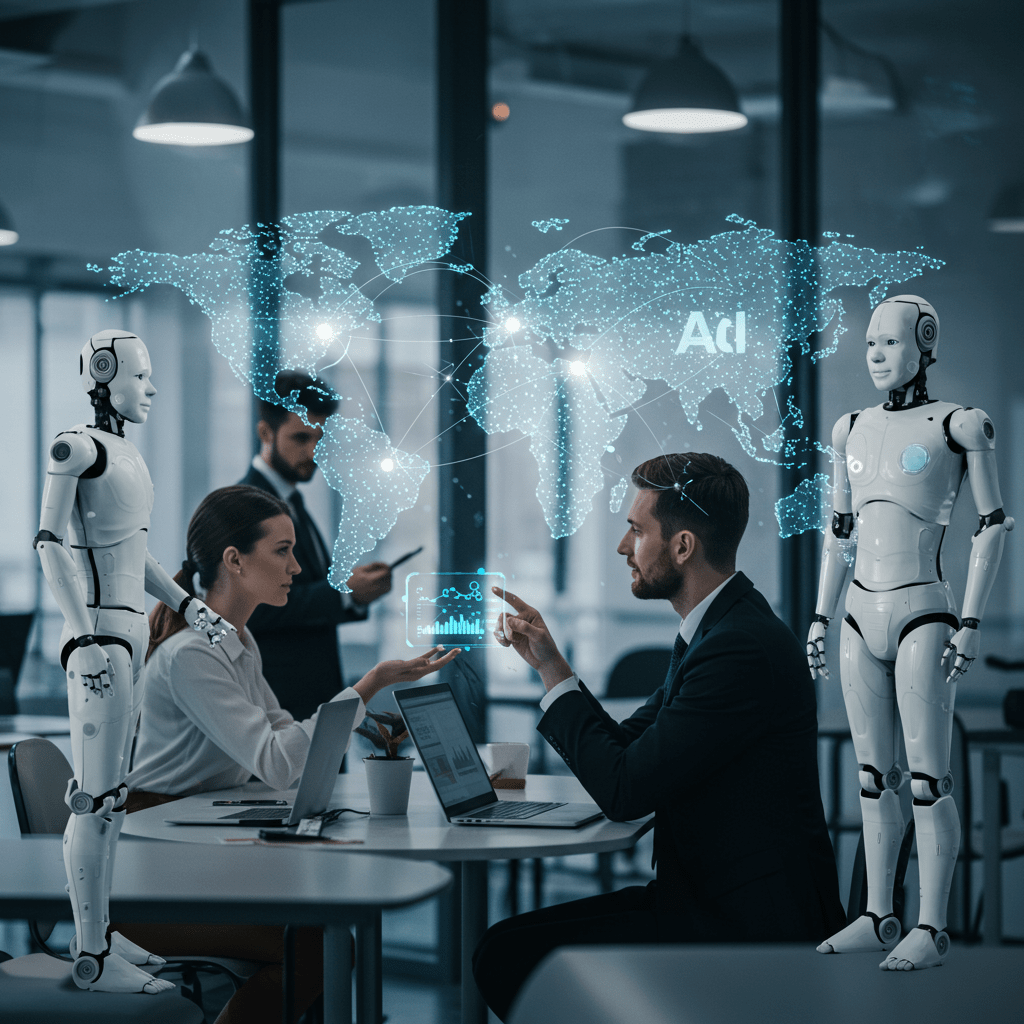
How AI Agents Revolutionise Global Business

AI agents are fundamentally transforming how businesses operate across the globe. Furthermore, these intelligent systems are enabling organisations to achieve unprecedented levels of efficiency and innovation. Consequently, companies that embrace AI-driven solutions are positioning themselves at the forefront of their respective industries.
Moreover, the integration of AI agents into business operations represents a paradigm shift from traditional manual processes to intelligent automation. However, the true power lies not just in automation, but in the strategic advantages these systems provide. Therefore, understanding how AI agents revolutionise global business operations becomes essential for any forward-thinking organisation.
Understanding AI Agents and Their Role in Business
AI agents represent sophisticated software systems that possess autonomous capabilities to perform tasks, make decisions, and continuously learn from their experiences. Furthermore, these intelligent entities operate independently while maintaining alignment with business objectives and parameters. Consequently, they serve as digital workforce members that enhance rather than replace human capabilities.
Additionally, AI agents demonstrate remarkable decision-making processes through advanced algorithms and machine learning models. However, their true strength lies in their ability to process vast amounts of data simultaneously whilst maintaining consistency in their outputs. Therefore, businesses can rely on these systems to handle complex scenarios that would typically require significant human resources.

Moreover, different types of AI agents serve various business functions, from reactive agents that respond to specific triggers to proactive agents that anticipate needs and take preventive actions. Furthermore, these systems integrate seamlessly with existing business infrastructure through APIs and cloud-based platforms. Consequently, organisations can implement AI agents without completely overhauling their current systems.
The continuous learning features of AI agents enable them to improve their performance over time through experience and feedback. However, this learning process is guided by predefined parameters to ensure alignment with business goals. Therefore, companies benefit from systems that become increasingly efficient and accurate with each interaction.
The Benefits of Using AI Agents for Business Operations
The implementation of AI agents in business operations delivers substantial benefits that directly impact the bottom line. Furthermore, organisations typically experience operational cost reductions of 15-25% within the first year of deployment. Consequently, the return on investment becomes evident relatively quickly, making AI agents an attractive proposition for businesses of all sizes.
Additionally, AI agents operate continuously without the limitations of traditional working hours, providing 24/7 availability that enhances customer service and operational efficiency. However, this constant availability doesn’t come at the expense of quality, as AI agents maintain consistent performance standards regardless of the time or workload. Therefore, businesses can offer superior service levels whilst reducing staffing costs.
Moreover, enhanced data-driven decision-making represents another significant advantage of AI agents for business operations. Furthermore, these systems can analyse complex datasets in real-time, identifying patterns and insights that might escape human observation. Consequently, strategic decisions become more informed and accurate, leading to better business outcomes.
The scalability benefits of AI agents prove particularly valuable for both startups and large enterprises. However, startups benefit from the ability to compete with larger organisations without massive infrastructure investments. Therefore, AI agents level the playing field by providing access to sophisticated capabilities regardless of company size.
How AI Agents Enhance Team Collaboration and Workflow
AI agents significantly improve team collaboration by automating routine communications and streamlining information flow between team members. Furthermore, these systems can summarise lengthy meetings, extract key action items, and distribute relevant information to appropriate stakeholders. Consequently, teams spend less time on administrative tasks and more time on strategic initiatives.
Additionally, AI-driven collaboration tools facilitate seamless interaction between human teams and AI agents, creating a hybrid workforce that maximises the strengths of both. However, the integration process requires careful planning to ensure smooth adoption and optimal results. Therefore, organisations must invest in proper training and change management to realise the full benefits.
Moreover, project workflow management becomes significantly more efficient when AI agents handle routine monitoring, progress tracking, and resource allocation tasks. Furthermore, these systems can predict potential bottlenecks and suggest proactive solutions before issues impact project timelines. Consequently, project success rates improve whilst reducing the stress and workload on human project managers.
The transformation of global team dynamics through AI agents demonstrates how these systems break down geographical and temporal barriers to collaboration. However, successful implementation requires understanding the unique challenges of distributed teams. Therefore, AI agents must be configured to accommodate different time zones, languages, and cultural considerations.
Scalable AI Solutions for Global Business Challenges
AI agents provide scalable solutions that adapt dynamically to growing business needs across different industries and geographical locations. Furthermore, these systems can handle increasing workloads without proportional increases in infrastructure costs or human resources. Consequently, businesses can expand their operations more efficiently and cost-effectively than traditional scaling methods would allow.

Additionally, platforms like agents24x7 enable businesses to deploy AI agents that handle complex workflows with remarkable sophistication. However, the true value lies in their ability to monitor inventory levels, forecast demand patterns, and respond to changing market conditions in real-time. Therefore, companies can maintain competitive advantages through superior responsiveness and agility.
Moreover, the global nature of modern business requires solutions that can operate across different regulatory environments, currencies, and market conditions. Furthermore, AI agents can be programmed to understand and comply with local requirements whilst maintaining consistency in core business processes. Consequently, multinational organisations can achieve standardisation without sacrificing local relevance.
The adaptability of AI agents proves particularly valuable when businesses face unexpected challenges or opportunities. However, this flexibility must be balanced with stability to ensure reliable operations. Therefore, successful AI agent implementations include robust monitoring and governance frameworks that maintain performance standards whilst allowing for necessary adaptations.
Practical Use Cases of AI Agents in Various Industries
In the finance sector, AI agents revolutionise operations by automating fraud detection, processing loan applications, and providing personalised investment advice. Furthermore, these systems can analyse market trends and execute trades with precision that surpasses human capabilities. Consequently, financial institutions can offer superior services whilst reducing operational risks and costs.
Additionally, retail businesses leverage AI agents for inventory management, customer service, and personalised marketing campaigns. However, the most significant impact comes from their ability to predict consumer behaviour and optimise supply chains accordingly. Therefore, retailers can reduce waste, improve customer satisfaction, and increase profitability simultaneously.
Moreover, healthcare organisations utilise AI agents for patient monitoring, appointment scheduling, and diagnostic support. Furthermore, these systems can analyse medical records to identify potential health risks and recommend preventive measures. Consequently, healthcare providers can deliver more proactive and personalised care whilst managing resources more efficiently.
The logistics industry benefits tremendously from AI agents that optimise routing, manage warehouse operations, and coordinate complex supply chains. However, the integration of these systems requires careful consideration of existing processes and stakeholder needs. Therefore, successful implementations often involve phased approaches that gradually expand AI agent responsibilities.
Implementing AI Agents with agents24x7 Platform
The agents24x7 AI agents platform offers comprehensive features that simplify the implementation and management of AI agents across various business functions. Furthermore, the platform’s ease of integration allows organisations to deploy AI agents without extensive technical expertise or infrastructure changes. Consequently, businesses can begin realising benefits quickly whilst minimising implementation risks and costs.
Additionally, real-time adaptability represents a key strength of the agents24x7 platform, enabling AI agents to respond dynamically to changing business conditions and requirements. However, this flexibility is balanced with robust governance controls that ensure consistent performance and compliance. Therefore, organisations can maintain confidence in their AI agent operations whilst benefiting from adaptive capabilities.
Moreover, the platform’s support for autonomous task execution enables AI agents to operate independently whilst maintaining alignment with business objectives. Furthermore, comprehensive monitoring and reporting capabilities provide visibility into AI agent performance and impact. Consequently, organisations can continuously optimise their AI agent implementations to maximise value and effectiveness.
The comprehensive tutorial for the agents24x7 platform demonstrates how international companies can leverage these capabilities to automate operations and enhance collaboration. However, successful implementation requires understanding the specific needs and constraints of each organisation. Therefore, the platform offers customisation options that accommodate diverse business requirements and preferences.
Furthermore, the agents24x7 platform provides scalable architecture that grows with business needs, ensuring that AI agent capabilities remain aligned with organisational objectives. Additionally, ongoing support and updates ensure that the platform continues to deliver value as technology and business requirements evolve. Consequently, organisations can view their AI agent investment as a long-term strategic advantage rather than a short-term tactical solution.
Conclusion
AI agents are fundamentally revolutionising global business operations by providing unprecedented levels of automation, collaboration, and scalability. Furthermore, platforms like agents24x7 empower businesses to harness these AI-driven efficiencies whilst maintaining the flexibility to adapt to changing market conditions. Consequently, organisations that embrace AI agents position themselves for sustained competitive advantage in an increasingly digital marketplace.
Moreover, the evidence clearly demonstrates that AI agents deliver tangible benefits across all business functions and industries. However, success requires thoughtful implementation that considers organisational culture, existing processes, and strategic objectives. Therefore, businesses must approach AI agent adoption as a transformative journey rather than a simple technology upgrade.
Additionally, the future of business operations will increasingly depend on the intelligent integration of human capabilities with AI agent automation. Furthermore, organisations that master this integration will lead their industries in innovation, efficiency, and customer satisfaction. Consequently, the question is not whether to adopt AI agents, but how quickly and effectively organisations can implement these revolutionary technologies to drive their success.
Related reading