


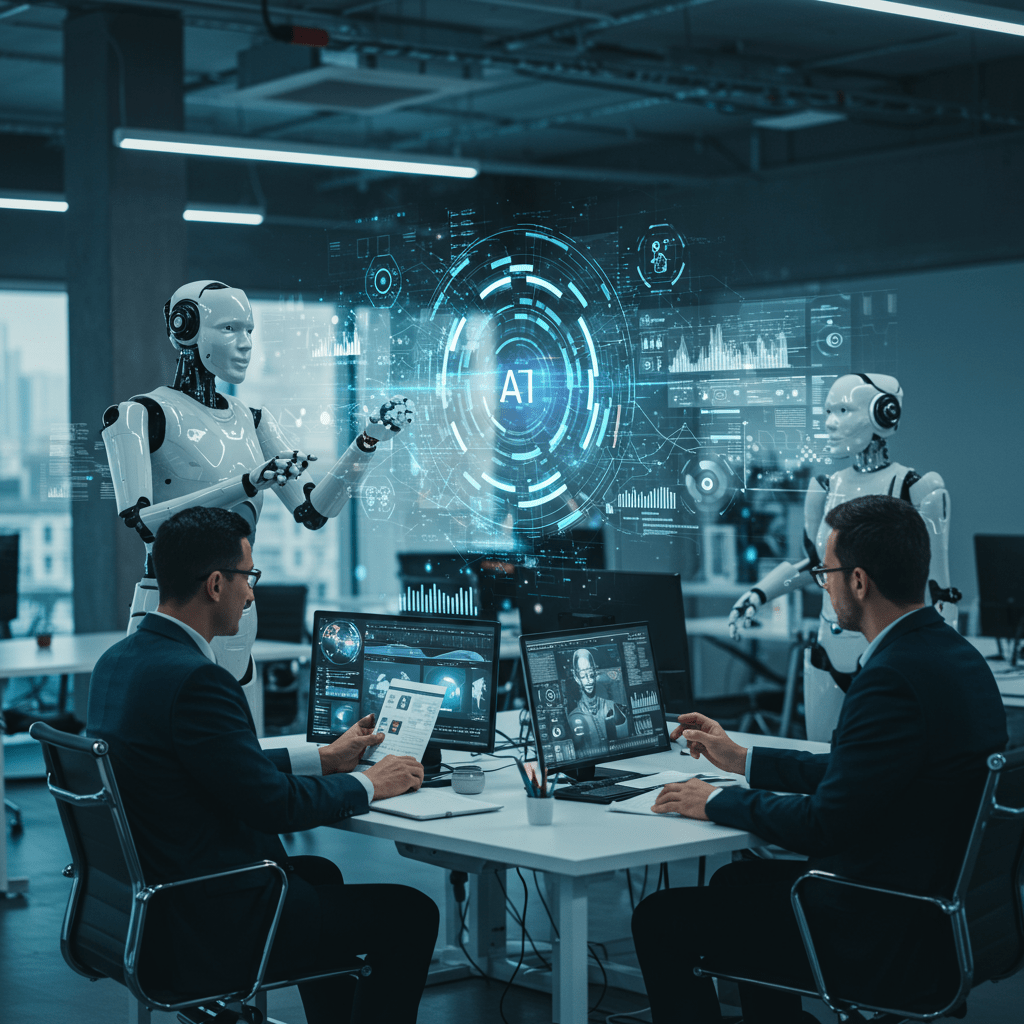
AI Agents Replace Human Roles in Tech Leadership

The technological landscape is experiencing a revolutionary transformation as artificial intelligence agents increasingly take on roles traditionally performed by human professionals. Furthermore, this shift represents more than mere automation—it signifies a fundamental reimagining of how businesses operate, particularly in tech leadership positions. Consequently, organisations worldwide are discovering that AI agents can deliver unprecedented efficiency whilst reducing operational costs significantly.
Moreover, the emergence of sophisticated AI platforms has enabled startups and enterprises to access high-level strategic capabilities previously available only to large corporations with substantial resources. However, this transformation raises important questions about the future of human roles in technology leadership and the evolving relationship between artificial intelligence and human expertise.
Understanding AI Agents and Their Role in the Modern Workplace
AI agents represent sophisticated software systems designed to perform complex tasks autonomously, making decisions and executing actions without constant human oversight. Furthermore, these intelligent systems have evolved far beyond simple automation tools, incorporating advanced machine learning algorithms that enable them to adapt and improve their performance over time. Consequently, modern AI agents can handle intricate workflows, analyse vast datasets, and provide strategic insights that were previously the exclusive domain of experienced professionals.

The Agents24x7 platform exemplifies this evolution, offering businesses access to AI agents capable of managing complex operational tasks with remarkable precision. Moreover, these agents demonstrate capabilities in project management, strategic planning, and decision-making processes that traditionally required years of human experience to master. However, the true power of AI agents lies not in replacing human creativity but in augmenting human capabilities and freeing professionals to focus on higher-value strategic initiatives.
Additionally, the growing role of AI agents in business environments reflects a broader trend towards intelligent automation that extends beyond simple task execution. Furthermore, these systems can learn from patterns, predict outcomes, and adapt their approaches based on changing circumstances, making them invaluable assets for organisations seeking competitive advantages in rapidly evolving markets.
How AI Agents24x7 Platform Transforms Tech Leadership
The transformation of tech leadership through AI agents represents one of the most significant developments in modern business operations. Furthermore, the Agents24x7 platform specifically addresses the challenges faced by organisations seeking effective technology leadership without the substantial costs associated with traditional executive hiring. Consequently, businesses can now access sophisticated strategic capabilities that complement or enhance their existing leadership structures.
Moreover, AI agents excel in project oversight by continuously monitoring progress, identifying potential bottlenecks, and suggesting optimisation strategies in real-time. However, their capabilities extend far beyond simple project management to encompass strategic planning functions that traditionally required extensive human expertise. Additionally, these systems can analyse market trends, assess technological opportunities, and provide data-driven recommendations for strategic decision-making.
The integration of AI agents with fractional CTO services represents a particularly innovative approach to technology leadership. Furthermore, this combination allows startups and enterprises to benefit from both human strategic insight and AI-driven operational efficiency. Consequently, organisations can achieve scalable leadership solutions that adapt to their evolving needs without the fixed costs associated with traditional executive positions.
As highlighted in recent research on AI breakthroughs transforming CTO services, the integration of artificial intelligence in technology leadership roles is revolutionising how organisations approach strategic planning and operational management. Moreover, these developments demonstrate the potential for AI to enhance rather than replace human leadership capabilities.
AI Automation in Startups and Enterprise Operations
The impact of AI agents extends significantly beyond leadership roles, transforming operational functions across startup and enterprise environments. Furthermore, these intelligent systems excel at automating routine tasks that previously consumed substantial human resources, allowing teams to focus on innovation and strategic initiatives. Consequently, organisations report dramatic improvements in operational efficiency and cost reduction following AI agent implementation.
Workflow optimisation represents another critical area where AI agents demonstrate exceptional value. Moreover, these systems can analyse existing processes, identify inefficiencies, and implement improvements automatically, often achieving results that surpass human-designed optimisations. However, the true power of AI automation lies in its ability to continuously learn and adapt, ensuring that operational improvements evolve alongside changing business requirements.
AI-driven recruitment exemplifies the transformative potential of intelligent automation in enterprise operations. Furthermore, AI agents can screen candidates, conduct initial assessments, and even manage onboarding processes with remarkable accuracy and efficiency. Additionally, these systems can identify talent patterns and predict candidate success rates, providing organisations with unprecedented insights into their hiring processes.
The comprehensive approach to AI and automation trends demonstrates how organisations are leveraging these technologies to create more efficient, responsive, and scalable operations. Moreover, the integration of AI agents into various operational functions creates synergies that amplify the benefits across entire organisations.
AI Agents in Crisis Management and Decision Support
Crisis management represents one of the most critical applications of AI agents in modern technology environments. Furthermore, these intelligent systems excel at processing vast amounts of real-time data, identifying patterns that might escape human attention, and providing rapid response recommendations during critical situations. Consequently, organisations equipped with AI-driven crisis management capabilities demonstrate superior resilience and recovery rates compared to those relying solely on human response teams.

The analytical capabilities of AI agents enable them to process complex datasets and identify potential risks before they escalate into full-scale crises. Moreover, these systems can monitor multiple data streams simultaneously, providing comprehensive situational awareness that would be impossible for human teams to maintain consistently. However, the true value of AI agents in crisis management lies in their ability to maintain objectivity and analytical precision under pressure.
Real-time data processing capabilities allow AI agents to provide immediate insights and recommendations during rapidly evolving situations. Furthermore, these systems can simulate various response scenarios, helping organisations choose the most effective strategies for crisis resolution. Additionally, AI agents can coordinate response efforts across multiple departments and stakeholders, ensuring coherent and efficient crisis management.
The Agents24x7 platform’s approach to crisis management demonstrates how AI agents can provide continuous monitoring and proactive responses to potential operational disruptions. Moreover, these systems can learn from past incidents, improving their predictive capabilities and response strategies over time. Consequently, organisations benefit from increasingly sophisticated crisis management capabilities that evolve alongside their operational complexity.
The Future of AI Workforce Automation and Human Collaboration
The evolving relationship between AI agents and human employees represents a fundamental shift towards collaborative intelligence rather than simple replacement scenarios. Furthermore, this transformation emphasises the complementary nature of human creativity and AI efficiency, creating opportunities for enhanced productivity and innovation. Consequently, organisations that successfully integrate AI agents with human teams often achieve superior results compared to those pursuing purely automated or purely human approaches.
Ethical considerations play a crucial role in shaping the future of AI workforce automation. Moreover, responsible implementation of AI agents requires careful attention to transparency, accountability, and fairness in decision-making processes. However, when properly managed, AI agents can actually enhance ethical decision-making by providing objective analysis and reducing human biases that might otherwise influence critical choices.
Workforce transformation through AI integration creates new opportunities for human professionals to engage in higher-value activities. Furthermore, as AI agents handle routine tasks and data processing, human employees can focus on strategic thinking, creative problem-solving, and relationship building. Additionally, this shift often leads to increased job satisfaction as professionals engage in more meaningful and challenging work.
The potential for AI to augment human creativity and leadership represents one of the most exciting aspects of this technological evolution. Moreover, AI agents can provide data-driven insights that inform human decision-making, whilst human professionals contribute contextual understanding and creative solutions that AI systems cannot replicate. Consequently, the combination of human intuition and AI analysis often produces superior outcomes compared to either approach alone.
Agents24x7 positions itself at the forefront of this collaborative future by offering AI solutions that integrate seamlessly with human teams. Furthermore, the platform’s approach emphasises enhancement rather than replacement, ensuring that organisations can leverage AI capabilities whilst preserving the unique value that human professionals bring to their operations. Moreover, this philosophy reflects a broader understanding that the future of work lies in intelligent collaboration between humans and AI systems.
Conclusion
The transformation of tech leadership through AI agents represents a paradigm shift that extends far beyond simple automation. Furthermore, platforms like Agents24x7 demonstrate how intelligent systems can enhance human capabilities whilst providing cost-effective, scalable solutions for organisations of all sizes. Consequently, the future of technology leadership lies not in choosing between human and AI capabilities but in creating synergistic relationships that leverage the strengths of both.
Moreover, the evidence clearly indicates that AI agents are reshaping operational roles by automating key tasks, enhancing efficiency, and supporting strategic decision-making processes. However, the most successful implementations recognise that AI-driven transformation works best when it fosters collaboration between humans and AI systems rather than pursuing complete replacement strategies.
As we move forward, the organisations that thrive will be those that embrace this collaborative approach, using AI agents to augment human creativity and strategic thinking whilst maintaining the human elements that drive innovation and meaningful relationships. Furthermore, the continued evolution of platforms like Agents24x7 ensures that businesses will have access to increasingly sophisticated AI solutions that integrate seamlessly with human teams, creating smarter, more efficient, and more innovative workforces for the future.
Related reading